Diverse Sampling for Referential Games
Bachelor thesis on the impact of decoding algorithms on candidate diversity and accuracy in pragmatic reasoning.
More About the Project
Python | NLP | LSTM | Decoding Algorithms
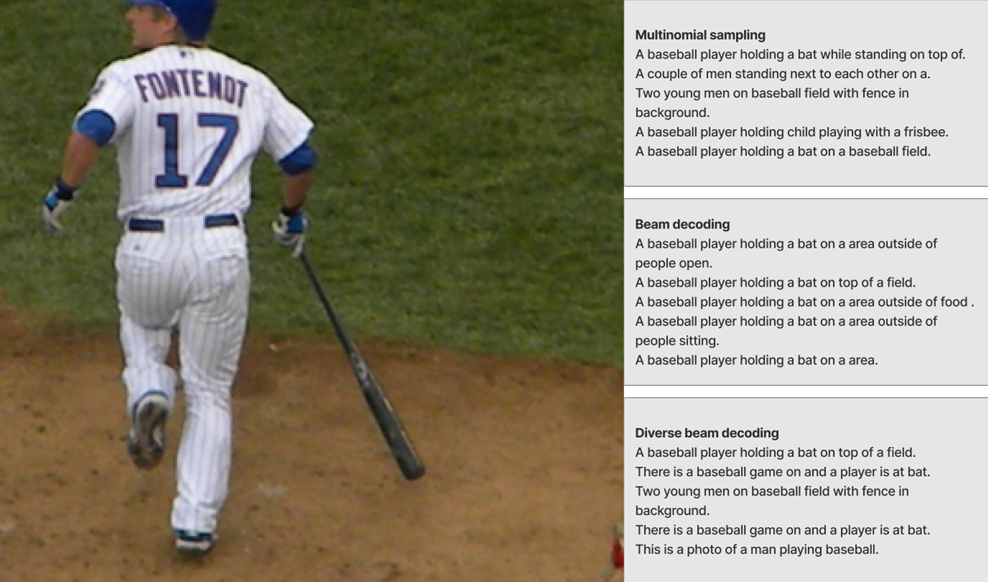
This thesis investigates which decoding algorithm generates the best candidate utterances for a pragmatic speaker in a referential image game. The speaker must describe a target image to a listener to distinguish it from two distractors. The study compares Multinomial Sampling, Beam Decoding, and Diverse Beam Decoding on 'easy' (random) and 'hard' (visually/textually similar) distractors. The findings show that candidate diversity is crucial for success, and while DBD is the most promising for accuracy, it suffers from high computational costs compared to Multinomial Sampling.
Bachelor Thesis
My Contributions
Pragmatic Model Implementation
Implemented a full pragmatic reasoning pipeline based on the Rational Speech Act framework.
Constructed a Pragmatic Speaker that samples candidates from a Literal Speaker (LSTM) and re-ranks them using a Literal Listener (ResNet/ROBERTa).
Decoding Algorithm Comparison
Implemented and systematically compared three distinct decoding algorithms: Multinomial Sampling, Beam Decoding, and Diverse Beam Decoding.
Analyzed the trade-offs between candidate diversity (measured by Distinct n-grams) and model performance (measured by Accuracy and Entropy).
Experimental Design and Analysis
Designed an evaluation setup using the MS COCO dataset with two distinct difficulty levels: ‘easy’ (random distractors) and ‘hard’ (semantically similar distractors).
Created the ‘hard’ dataset by selecting distractors based on high visual and textual cosine similarity.